Available Settings - InStore App
All settings and options described here apply to version 1.3.3 of the InStore App.
If you are using an older version, some settings may differ or may not be available at all.
Main settings
Operation Mode
Defines which features are available in the UI. Some options and sections appear or hide based on this selection:
- Consumer – Customer-facing (receipt display/printing). Allows changing Print Delay, which is not available in Merchant mode.
- Merchant – Merchant/admin. Cannot change Print Delay, but offers extra gestures:
- Pull down on the QR code screen to show the receipt.
- Pull up to reveal action buttons.
As merchante mode is usually used in an environment where the InStore App is not the main application used on the host device, selecting Merchant mode automatically enables Enable running in Background.
Terminal ID Filter
Filters receipts and data for a specific terminal within the CashBox.
For advanced multi-terminal options, see Multiterminal Settings
Enable running in Background
Runs the app as an Android foreground service also displaying a notification in the Android status bar (when notifications are enabled in Android settings) that shows "InStore App is running in the background". The service takes care that the app is run at all times.
When enabled it results in the following behaviour:
- Even if the InStore App is not in foreground (e.g., the user is working with the POS app on the same device), it continues to run in the background.
- The InStore App auto‑starts after device boot so no manual start is required after boot. This means even without ever starting the InStore App manually it will start in the background automatically and can process actions (like trigger payments or show receipts).
This setting is mandatory for Android 15+.
Use local configuration
If enabled, local device settings override the backend configuration.
If disabled, the app follows centrally managed (backend) settings.
Once the setting is disabled and the app is restarted, the configuration stored in the backend will be loaded into the app.
This configuration can be applied:
- Per device: A specific configuration for each individual device.
- Per cashbox: A shared configuration for all devices connected to a particular cashbox.
Printer settings
When you tap on Printer, a subpage will open where you can select a printer. Any remaining print options will appear after selecting a physical printer.
Printer
Shows all available printers (USB, Bluetooth, ESC POS Network printing, ... ). Select the one you want to use. Select No printing if no printer is used on this device. Some payment terminals also expose an integrated printer and are tied to the payment configuration (e.g. the Shift4 Commerce Engine printer). Such printers might only appear after the payment provider was configured. Therefore we suggest to first configure Payment and afterwards the printer.
Print Delay
Defines the delay before an issued receipt will get printed automatically if the guest/customer is not receiving the receipt in another way like scanning the QR code with their phone, just accepting it by pressing OK or another method.
Default: 30s. Available only in Consumer mode.
Paper width
Set the receipt width: 48 mm, 72 mm, or 80 mm.
IP Address / IP Port
Shown only when ESC POS Network printing is selected. Enter the printer's network IP Address and IP Port (default port 9100).
Print Demo
Executes a simple "demo" test print to check basic printer functionality.
Payment settings
Tapping Payment Method opens a sub-page where you select and configure a payment provider.
Payment Method
Select the payment provider to use on this device. All supported payment service providers and the payment features available for each of them are listed in the PSP feature matrix.
You can only select payment providers that work on this device. The list is grouped as follows:
- No payment (at the top) – All payment requests are ignored. Use this option when the InStore App is only used for receipts and printing (similar to the No printing printer option).
- Payment apps on this device – Providers that hand the payment over to a payment app (SoftPOS and app-based providers). They can only be selected when the provider's payment app (production or sandbox) is installed on the same device. Each entry shows which installed app will be used.
- Payment terminals (network) – Providers that connect to a payment terminal over the network.
- Testing – The Dummy Payment Provider, only visible when paired with a sandbox CashBox. For more information, see Dummy Payment Provider.
- Not available on this device (at the bottom) – Providers whose payment app is not installed. They are shown disabled and cannot be selected.
If the payment app of the selected provider is uninstalled later, the InStore App behaves like No payment. The setting is kept and applies again as soon as the payment app is reinstalled.
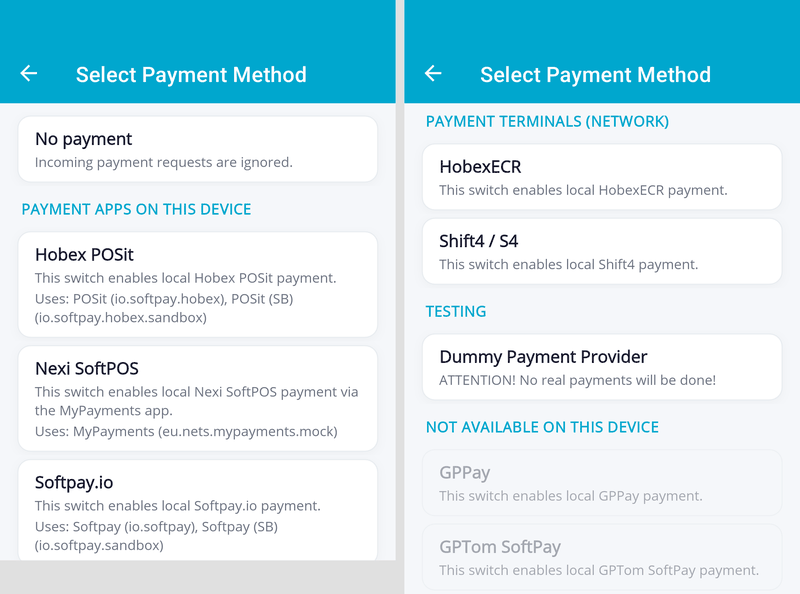
Figure 1. The payment provider list, grouped by payment apps on the device, network terminals, testing and providers not available on this device.
Providers that require additional configuration in the InStore App are described below. Leading and trailing spaces in entered values (for example an API key pasted from the clipboard) are removed automatically.
Use Sandbox app (internal / sandbox builds only)
Some payment providers offer a Use Sandbox app switch. When enabled, the InStore App uses the provider's sandbox payment app instead of the production app. This switch is only available when the InStore App is paired with a sandbox CashBox.
HobexECR
- Terminal ID – The terminal ID assigned by Hobex.
- Password – The password for ECR integration (tap the eye icon to reveal/hide it).
- Host – Hostname or IP of the ECR endpoint (default
localhost). - Port – TCP port of the ECR endpoint (default
9990).
Shift4
- Auth Token – The merchant auth token which will be provided by the merchant's Lighthouse Transaction Manager Account Administrator. The expected format is
12345678-ABCD-1234-ABCD1234567890EF(uppercase hex); an inline message is shown if the format is invalid. For further help please refer to Shift4 support. - Commerce Engine Host – The Commerce Engine host address to connect to and process payment requests. If not otherwise provided by fiskaltrust support please use 127.0.0.1:8085.
- Allow API Debugging – Allows insecure certificates for troubleshooting. Do not use in production.
SumUp
Payments are processed through the installed SumUp app (PaymentSwitch) with a connected SumUp Solo or Solo Light reader.
- API Key – The merchant's SumUp API key (see SumUp: API keys). When configured, the InStore App additionally uses the SumUp cloud API for refund, cancel, and detailed payment receipts with the full transaction details. Without an API key, only payment is available.
See the notes on SumUp in the PSP feature matrix for the exact scope.
Test Communication
Available for some payment solutions only. Checks connectivity with the configured payment endpoint before going live.
Other
Advanced
Enable webview URL
When enabled, the website represented by the configured URL is shown on the home screen (the idle "no active session" view) instead of the default screen. Enter a valid http:// or https:// URL in the field that appears. While the toggle is on but the field is empty or the URL is invalid, the app keeps showing the default home screen and displays an inline warning.
Lock settings via PIN
When enabled, opening the Settings page requires a 6‑digit PIN. This prevents unwanted configuration changes (e.g. by waiters).
- When you enable the lock, the app shows the PIN once so you can note it down.
- Disabling the lock also requires entering the PIN.
- After 5 wrong attempts within one hour, PIN entry is locked for up to an hour.
Logs
The InStore App writes its logs to files on the device, so that issues can be analyzed after they happened. Log files are kept for up to 31 days and compressed automatically. Personal data such as customer e-mail addresses and phone numbers, as well as secrets like API keys, are masked.
- Log level – How detailed the logs are.
- Total size – The maximum storage space used for logs, i.e. the current live log file plus the rolled log files.
- Current live log file – The maximum size of the log file currently being written before it is rolled.
- Export logs – Opens a page to select a date range (From / To) and export the logs of these days as a ZIP file. The estimated size is shown. The export can be shared directly (Share), saved to a folder (Save to folder) or saved to the Downloads folder (Save to Downloads).
Please attach this export when you contact fiskaltrust support about an issue.
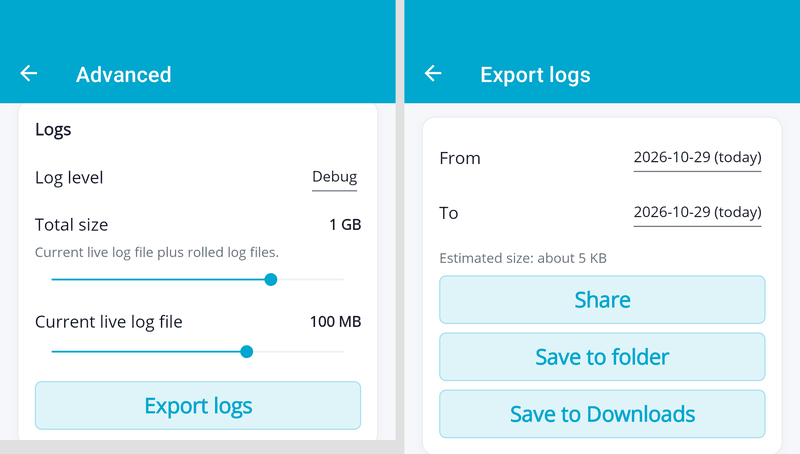
Figure 2. The Logs section in the Advanced settings and the Export logs page.
Enable B2B Invoice delivery (PREVIEW)
Only visible when paired with a sandbox CashBox. When enabled, the receipt page shows an additional Send B2B Invoice button. With it, the cashier identifies the business customer (VAT number lookup via VIES or manual entry) and sends the invoice via Peppol or e-mail.
Unpair CashBox
Disconnects the current CashBox to pair another one (e.g., when moving the device to a new store).
Quit App
Closes the app gracefully after a confirmation prompt and persists configuration changes.
It also stops the background service, so Enable running in Background is no longer active until the app is started again.
Note: Closing during an active process (e.g., printing) may interrupt that process — finish ongoing tasks first.
About
Tapping About opens a sub-page showing device and app information. (All fields are read‑only.)
- IP Address – The current IP address of the device on your network. Use it when setting up network printing or firewall rules. Only appears when the device is connected via LAN/WLAN; hidden when using mobile data.
- Device Type – The device model/type (e.g., terminal vendor and model). Useful to identify hardware-specific behavior.
- Device ID – The unique identifier of this device. Quote this ID when contacting support or managing a fleet. Tap it to show the full ID in a popup.
- CashBox ID – The CashBox the app is paired with. Tap it to show the full ID in a popup.
- Support contact – Displays the fiskaltrust support email address.
- Version – The currently installed app version.
Best practices
- Keep Use local configuration off if you manage settings centrally — this prevents drift from backend policies.
- Use Test Communication before going live when available.